PF Series Impact Crusher | Medium-Fine Crushing and Particle Shaping Equipment for Medium-Hard Gold Ore
The PF series impact crusher (abbreviated impact crusher) is the main medium-fine crushing and shaping machine frequently used in gold processing plants to treat medium-hard, friable gold ore. It adopts the impact crushing principle and delivers a cubic product with uniform size and no stress cracks. In a gold plant the impact crusher is normally installed after the jaw crusher for second-stage medium crushing, reducing auriferous quartz veins and altered-type gold ore to the feed size required by the ball mill. Its large crushing ratio simplifies the number of stages and reduces civil investment. To address the concerns most critical in gold processing—liberation size and gold loss through over-crushing—the impact crusher precisely controls the discharge size by adjusting the gap between the impact bar and the rotor, reducing the generation of fine slime. Compressive strength not above 350 MPa, maximum feed size 500 mm; the full PF1010 to PF1320 range covers gold crushing and screening duties of 50–350 t/h. GoldProcessingPlant specializes in gold mining and processing equipment and supporting circuits, offering combined flowsheet packages and advising on impact crusher selection and crushing circuit layout according to ore hardness, throughput and grinding fineness.
Product Overview
The PF series impact crusher is a new-generation medium-fine crushing machine developed by integrating advanced domestic and foreign technologies and closely adapting to real conditions in the aggregates and mining sectors. With a unique structural design and top-grade wear-resistant materials, the impact crusher efficiently crushes a variety of medium-hard materials with compressive strength not exceeding 350 MPa (such as granite, limestone and concrete), accepting feed up to 500 mm. The crushed product is cubic, uniformly sized and free of stress cracks, with excellent particle shape, making it the ideal choice for high-quality aggregates. It is widely used in mining, building materials, railways, highways, energy, cement, chemicals and other sectors for ore crushing and material shaping.
In gold ore processing the role of the impact crusher is very clear: a cost-effective solution for second- and third-stage medium-fine crushing of medium-hard or softer gold ores. Auriferous quartz veins, altered-type gold ore and silicified fracture zones, after coarse jaw crushing, need a medium-fine machine that can consistently reduce the ore below 25 mm without generating excess fine slime—because mineral liberation occurs mainly in the downstream ball mill, and over-fine crushing at the crushing stage only increases clay formation, gold loss and power consumption per tonne. The impact-and-collision mode of the impact crusher breaks the ore selectively along internal fracture surfaces, with a high proportion of cubic particles and low content of flaky particles. In the ball mill the grinding media wear the ore more evenly and grinding fineness is easier to hold in the -200 mesh range required for gold liberation, stabilizing plant indices from the source. For limestone, marble, gold ore with calcareous and carbonaceous gangue and pre-wash crushing in alluvial gold plants, the impact crusher is the preferred model.
Working Principle
When gold ore enters the impact crusher, the high-speed rotating rotor drives the blow bars to strike the material violently and hurl it at high velocity against the impact plate, achieving the first break. After collision the material rebounds into the blow-bar zone, is struck again and collides with other projected particles. This cycle repeats in the first-, second- and third-stage impact chambers until multiple impacts and collisions reduce the material to the required size, which is finally discharged. Adjusting the gap between the impact bar and the rotor controls the discharge size flexibly.
This threefold impact—rebound—collision action is precisely why the product shape of the impact crusher surpasses that of other machines at the same size: the material is not broken by compression and attrition but fractured along its weak planes, so particles are cubic and free of stress cracks. For gold processing, a cubic particle shape means a concentrated size distribution entering the ball mill–spiral classifier closed-circuit grinding loop, higher classification efficiency, more complete gold liberation, and reduced loss of fine gold with the overflow as well as over-grinding clay formation caused by size fluctuations. At the same time, multiple collisions in the impact chamber also exert a certain liberating and scrubbing effect, benefiting subsequent washing and gravity recovery of alluvial and high-clay altered gold ores.
Main Advantages and Features
- Excellent product particle shape: adopting the impact crushing principle, the material receives multiple impacts and rubbing in the chamber; the product is predominantly cubic, low in flaky particles and high in commercial value, fully meeting high-quality aggregate standards. When used in gold processing, uniform size provides stable feed to the ball mill, favouring grinding fineness control and improving the liberation degree of gold minerals.
- Huge crushing ratio and high productivity: the deep-designed chamber and large rotor moment of inertia deliver abundant impact energy and a large crushing ratio, simplifying the crushing circuit and raising single-machine capacity with significant production efficiency. The gold ore crushing circuit can be compressed from three stages to two stages plus closed-circuit screening, saving the investment and power of one crusher and one conveyor.
- Robust, wear-resistant key components: the key crushing parts—blow bars made of high-chromium alloy—offer extremely high wear resistance and impact toughness, with long service life and lower maintenance cost. When treating strongly silicified auriferous quartz veins, high-chromium alloy or composite blow bars can be selected and rotor peripheral speed adjusted to keep the wear-part cost per tonne within a reasonable range.
- Easy operation and maintenance
- Keyless locking: the rotor and blow bars are fixed by a mechanical locking system; blow-bar replacement is more convenient, faster and more reliable, shortening maintenance downtime in the gold plant.
- Adjustable gap: the gap between the impact bar and the blow bars is easily regulated by a mechanical device, giving precise control of product size for diverse needs—fine-tune the gap to the feed size required by the ball mill without replacing parts.
- Compact structure and high rigidity: the overall design is compact and the machine has high rigidity. The rotor is dynamically balanced, runs smoothly and offers high reliability, especially suited to continuous operation in gold plants and aggregate lines; its small footprint makes it easy to integrate into existing crushing and screening circuits during old-plant upgrades.
- Coordinated protection with iron removal and screening equipment: the impact crusher is extremely sensitive to iron pieces; drill-rod remnants and liner fragments entering the chamber quickly destroy blow bars and impact plates. The gold plant should install a permanent magnetic separator above the feed belt and a heavy-duty trommel screen at the discharge to close the size circuit, sending qualified material to the ball mill and returning coarse material for re-crushing—forming a stable gold crushing system.
Technical Parameter Table
Note: capacity is closely related to hardness, moisture, material composition and final size requirement; the table gives reference ranges for medium-hard materials. When treating strongly silicified auriferous quartz veins, productivity decreases and wear-part consumption rises; calculation should be based on beneficiation tests and ore hardness data.
Gold selection recommendation: for small gold test lines or plants of 50–90 t/h, choose the PF1010; for medium plants treating auriferous quartz veins and altered ore, second-stage medium crushing usually uses PF1210 / PF1214 (70–180 t/h) in closed circuit with a 600×900 or 750×1060 jaw crusher and a circular vibrating screen; for large plants or oversized feed (feed edge 350–500 mm), choose PF1315 / PF1320 (120–350 t/h). If the gold ore is strongly silicified and highly abrasive (quartz-vein or quartzite type), first calculate the wear cost of blow bars and impact plates per tonne and, if necessary, opt for a PY series spring cone crusher for medium-fine crushing; if construction aggregates or manufactured sand are to be produced simultaneously, the particle-shape advantage of the impact crusher is even more evident. GoldProcessingPlant freely recommends the model, motor power and auxiliary screening equipment according to plant throughput, ore compressive strength and discharge size requirement.
Materials and Industries Served
- Applicable materials: limestone, bluestone, calcite, dolomite, coal, calcium carbide, slag, construction waste (concrete) and ores of medium hardness or below—that is, medium-hard, friable materials. In gold processing it applies to medium-fine crushing of altered-type gold ore, calcareous and carbonaceous gangue gold ore and moderately silicified auriferous quartz veins, as well as clayey agglomerate breaking and pre-wash treatment in alluvial gold plants (often arranged together with a double spiral washing machine).
- Unsuitable materials: extremely hard materials (such as basalt and cobbles) or excessively viscous materials cause severe wear of blow bars and impact plates. In gold processing, strongly silicified quartz veins, quartzite-type gold ore and hard ores with abundant visible gold should be handled by a spring cone crusher or high-pressure grinding roll to avoid excessive wear-part consumption.
- Industries served
- Mining (gold ore): medium and fine crushing in gold processing plants, providing qualified feed for ball-mill grinding and liberation; in old-plant upgrades the impact crusher replaces outdated medium-crushing equipment and improves productivity and particle-shape quality.
- Building materials and aggregates: production of high-quality manufactured sand and stone of various specifications; utilization of plant tailings and waste rock for sand making, achieving green mining and tailings reduction.
- Construction: treatment and recycling of construction waste.
- Cement and chemicals: pre-crushing of raw materials.
How to Choose Between an Impact Crusher and a Cone Crusher
In the medium-fine crushing stage, the two machines most often compared in gold plants are the impact crusher and the spring cone crusher; they are not substitutes but divide work according to ore nature:
- By hardness and abrasiveness: for gold ore below 350 MPa with moderate silicification, choose the impact crusher, with low cost per tonne and good particle shape; for strongly silicified, highly abrasive quartz-vein gold ore, choose the spring cone crusher, trading particle shape for longer wear-part life.
- By particle shape and clay content: when cubic aggregates, sand from waste rock and fewer flaky particles are required, choose the impact crusher; when the aim is to reduce fine slime and control over-crushing to protect gravity recovery, the cone crusher is more stable.
- By number of stages and investment: the large crushing ratio of the impact crusher allows three stages to be compressed into two, saving civil and motor investment; the cone crusher usually requires a spring medium crusher plus a short-head fine crusher.
- Typical gold configuration: jaw crusher (coarse crushing) → permanent magnetic separator (iron protection) → impact crusher or PYB spring cone (medium crushing) → circular vibrating screen closed circuit → ball mill (grinding and liberation) → hydrocyclone classification → flotation / jig / centrifugal concentrator / 6-S shaking table for gravity recovery of liberated gold. GoldProcessingPlant can issue two technical-economic comparison plans based on beneficiation test results.
Why Choose Our Impact Crusher
- Mature technology and reliable performance: the design has long been market-validated as a classic high-efficiency crushing model, with numerous long-term operating cases in gold plants and aggregate lines at home and abroad.
- High overall cost-effectiveness: although blow bars are wear parts, their extremely long replacement interval and very high crushing efficiency make the cost per tonne highly competitive; keyless locking and hydraulic/mechanical top-opening structure allow part changes and maintenance within a few hours, reducing gold-plant downtime losses.
- Flexible configuration plans: multiple models from PF1010 to PF1320 can be combined with jaw crushers, vibrating feeders, heavy trommels, circular vibrating screens and permanent magnetic separators to form a complete gold crushing and screening line, or integrated as a single unit into an existing circuit for upgrading.
- Professional technical support: full technical assistance from beneficiation testing and selection to installation, commissioning and maintenance, with auxiliary gold grinding and gravity equipment such as ball mills, hydrocyclones, jigs, centrifugal concentrators and 6-S shaking tables, ensuring the equipment creates maximum value for you.
Frequently Asked Questions
What is an impact crusher and what role does it play in gold processing?
The impact crusher is a medium-fine crushing machine that uses high-speed rotating blow bars to strike material and make it collide repeatedly between the impact plate and the various chambers. In a gold processing plant it performs second-stage medium crushing (or third-stage fine crushing) after the jaw crusher, reducing auriferous quartz veins and altered-type gold ore to the feed size required by the ball mill; the cubic, uniformly sized product stabilizes grinding fineness and improves the liberation degree of gold, while the large crushing ratio simplifies the number of stages and reduces civil works and plant investment.
Can an impact crusher be used for gold? Which gold ores suit it and which do not?
Yes, but selection must follow ore hardness and degree of silicification. Suitable: altered-type gold ore, carbonaceous and calcareous gangue gold ore, moderately silicified auriferous quartz veins, clay agglomerate breaking in alluvial gold, and shaping of plant waste rock and tailings into sand. Unsuitable: strongly silicified quartz veins, quartzite-type gold ore, basalt and cobbles—highly abrasive materials that require the PY series spring cone crusher, otherwise blow bars and impact plates wear too fast and the cost per tonne becomes excessive. GoldProcessingPlant recommends compressive strength and abrasiveness tests before deciding the model.
How do I choose between an impact crusher and a cone (spring cone) crusher?
Three criteria: first, hardness and abrasiveness—medium-hard friable material below 350 MPa takes the impact crusher, while highly silicified and abrasive material takes the cone crusher; second, particle-shape requirement—cubic aggregates and low flaky content favour the impact crusher; third, over-crushing control—when the aim is to reduce fine slime and protect gravity recovery, the layered compression crushing of the cone crusher is more stable. Common gold-plant practice is to use both machines by stage according to ore, or to compare two plans: jaw plus impact versus jaw plus PYB medium cone plus PYD fine cone.
What discharge size can an impact crusher achieve? Can it directly meet ball-mill feed requirements?
The maximum feed size of the PF series is 500 mm (PF1320); the discharge size is controlled by adjusting the gap between the impact bar and the rotor (blow bars). Normal medium-crushing product can be consistently kept below 25 mm and fine-crushing duty can be smaller still, fully meeting ball-mill feed size requirements. If a closed circuit with grinding fineness is desired, install a circular vibrating screen or heavy trommel at the discharge and return oversize for re-crushing, preventing non-conforming material from entering the mill and causing insufficient gold liberation or over-grinding gold loss.
What are the wear parts of an impact crusher? How long do blow bars last and what do they cost to change?
The main wear parts are high-chromium alloy blow bars, the impact plate (impact liner), blow-bar locking wedges, rotor bearings and V-belts. Blow-bar life depends on ore silicification and clay content: it is longer for limestone and altered-type gold ore and clearly shorter for strongly silicified auriferous quartz veins. Life can be extended by selecting high-chromium alloy or composite blow bars, reasonably lowering rotor peripheral speed and ensuring uniform feed. Keyless locking and mechanical clamping make blow-bar changes fast, normally within a few hours; GoldProcessingPlant can supply a wear-parts spare list and consumption-per-tonne calculation.
How is the discharge size of an impact crusher adjusted? What is the adjustment range?
It is achieved by adjusting the gap between the impact bar and the rotor (blow bars): the gaps of the first- and second-stage impact chambers can be adjusted separately; a smaller gap gives finer discharge and a larger gap gives higher productivity. Adjustment is mechanical, simple to operate and requires no part replacement. The actual adjustment range is influenced by rotor speed, blow-bar wear and material nature; it is recommended to determine the optimal gap through a crushing and screening test and then fine-tune it together with ball-mill grinding fineness (for example the -200 mesh percentage) and gold gravity recovery indices.
Which model suits a 50 t/h or 100 t/h gold plant?
According to the table: 50–90 t/h takes the PF1010 (55–75 kW motor, 14 t weight); 70–130 t/h takes the PF1210; 90–180 t/h takes the PF1214; 120–250 t/h takes the PF1315; and 160–350 t/h takes the PF1320. Actual gold selection must discount ore hardness, water and clay content and target size, generally leaving a margin of 75%–85% of nominal capacity. State your throughput, feed size and discharge requirements and GoldProcessingPlant will issue a complete configuration table with feeder, crusher, screen and iron separator.
What are the common faults of an impact crusher and how are they treated?
Four types are common in gold plants: (1) blow-bar breakage or dropping—usually caused by iron entering or loosened wedges; stop and inspect immediately and replace, and a permanent magnetic separator must be installed upstream; (2) excessive rotor vibration and abnormal noise—uneven blow-bar wear or loss of rotor dynamic balance; replace blow bars in groups and recalibrate; (3) bearing overheating—insufficient lubrication, dust in the seal or belts too tight; add the specified grease, clean the seal and adjust belt tension; (4) blockage and overly coarse discharge—overfeeding or an impact-plate gap that is too small; feed uniformly and widen the gap as needed while checking for a broken screen mesh. Record current and output daily; abnormal fluctuations often foreshadow wear-part damage or iron entry.
Can an impact crusher make sand and shape particles? Can gold waste rock be utilized?
Yes. Impact crushing produces a cubic product with few flaky particles and no stress cracks, making the impact crusher itself a common model for producing high-quality aggregates and shaping manufactured sand. The large volume of medium-hard waste rock generated by a gold plant during mine opening, tailings and waste-rock dumping can be turned into construction aggregates and manufactured sand through impact crusher plus vibrating screen plus sand-making unit, reducing pressure on tailings-dam volume and generating extra income—a common practice of green mining and tailings utilization in gold. GoldProcessingPlant can provide the corresponding waste-rock sand-making and aggregate-shaping circuit.
How much does an impact crusher cost? What information is needed for a quotation?
The price depends on the model (PF1010 / PF1210 / PF1214 / PF1315 / PF1320), motor power configuration, blow-bar and impact-plate materials, whether a vibrating feeder and screening equipment are included, and whether an iron separator and electric control system are provided. For an exact quotation, specify: gold plant throughput (t/h), ore name and compressive strength, maximum feed size, target discharge size, and site and installation mode (fixed or mobile). GoldProcessingPlant beneficiation and process engineers freely provide the selection plan, circuit layout drawing and complete-line quotation.
The PF series impact crusher has become a cost-effective choice for medium-fine crushing of medium-hard ores in gold plants thanks to four major characteristics: large crushing ratio, excellent particle shape, simple structure and convenient maintenance. It consistently reduces auriferous quartz veins and altered-type gold ore to the size required by the ball mill, creating conditions for gold liberation; its cubic product reduces over-crushing, clay formation and gold loss; and it also enables aggregate utilization of plant waste rock and tailings. According to the nature of your gold ore, throughput and target grinding fineness, GoldProcessingPlant offers impact crusher selection, wear-part configuration and an integrated "crushing—iron removal—screening—grinding—classification—gravity concentration" solution.



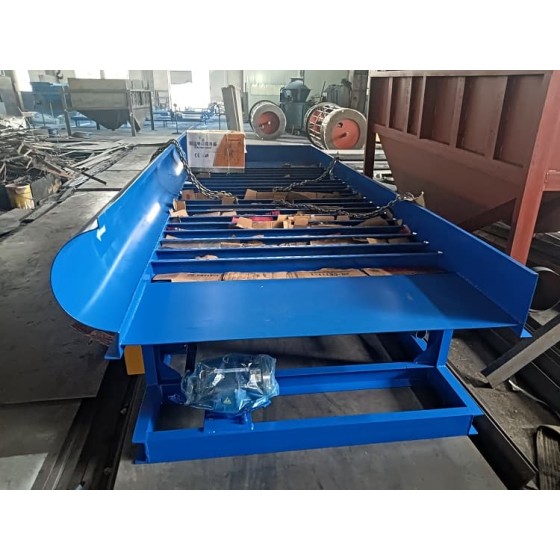
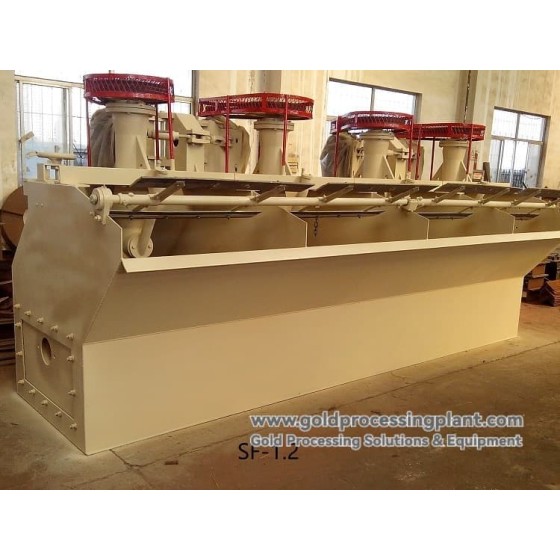
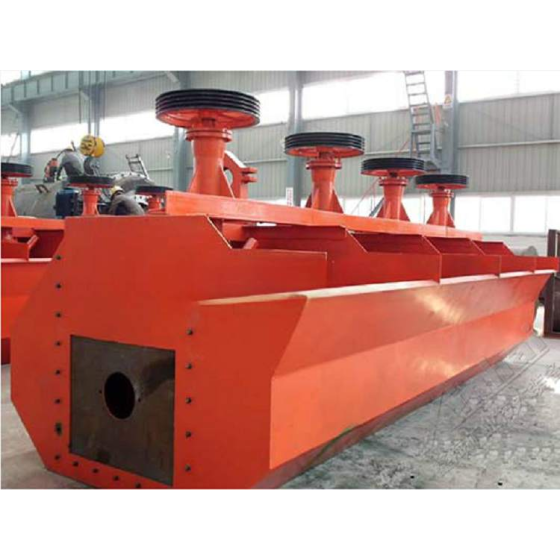
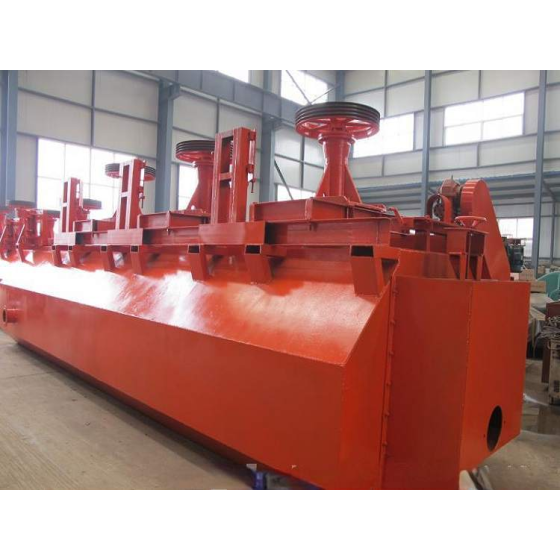
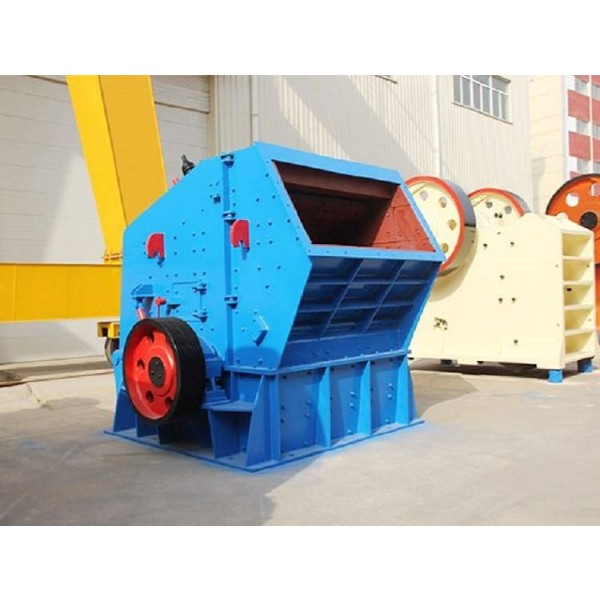
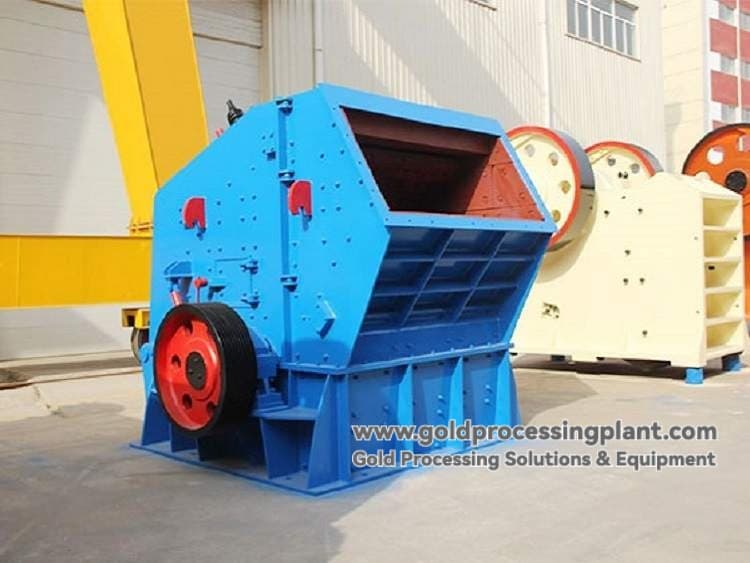 GoldProcessingPlant PF series impact crusher installed in a gold plant (rotor · blow bars · impact chamber inspection door)
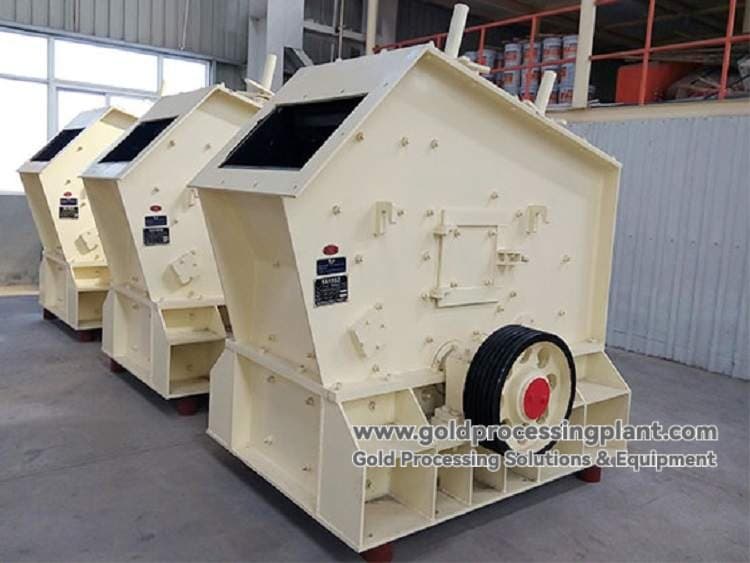 Impact crusher rotor, blow bars and impact plates (first-, second- and third-stage impact chambers · gap adjustment device)
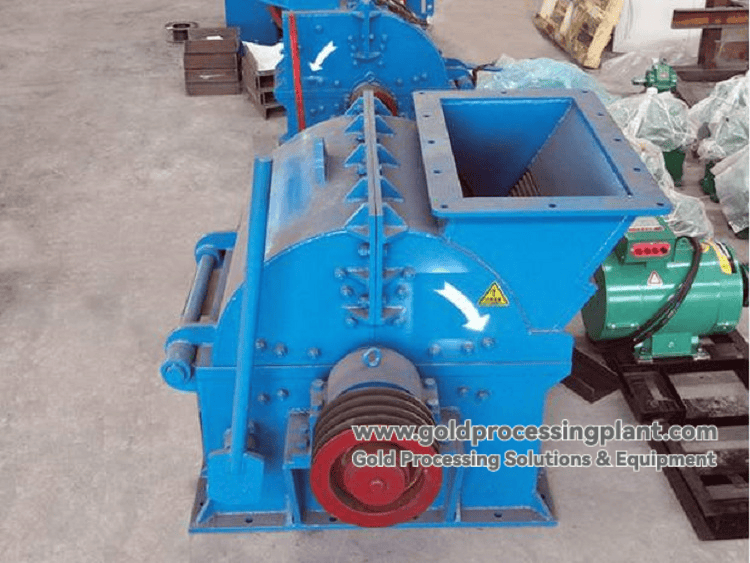 GoldProcessingPlant second-stage "jaw crusher + impact crusher + circular vibrating screen" unit at a gold plant