Centrifugal Concentrator | Gravity Recovery Equipment for Fine Liberated Gold from Gold Ore
The fully automatic gold centrifugal concentrator is an advanced gravity concentration device available today, developed specifically for the intensified recovery of fine liberated gold from gold ore, and it sets the technical benchmark for the gravity separation production line. It generates a powerful centrifugal force field through a high-speed rotating conical concentration cone, amplifying the gravity separation process by tens to hundreds of times. It is especially adept at capturing the fine liberated gold particles lost by conventional gravity equipment such as chutes and jigs during plant operation——alluvial gold recovery can exceed 99%, with concentration ratios as high as 1000 times; when vein gold ore is ground to a fineness of -0.074mm, liberated gold recovery remains stable above 98%, and even the 0.04mm fraction can reach over 97%. The equipment has been granted an invention patent in China and adds no mercury, cyanide, or any other chemical reagent throughout the process, making it a green, environmentally friendly choice to replace mercury amalgamation and efficiently recover native gold from auriferous quartz veins and old tailings. This article breaks down the centrifugal concentrator in six sections: product overview, working principle, advantages, applications, technical parameters, and FAQ, to help you select the right model and place it correctly in the circuit, optimizing overall gold recovery.
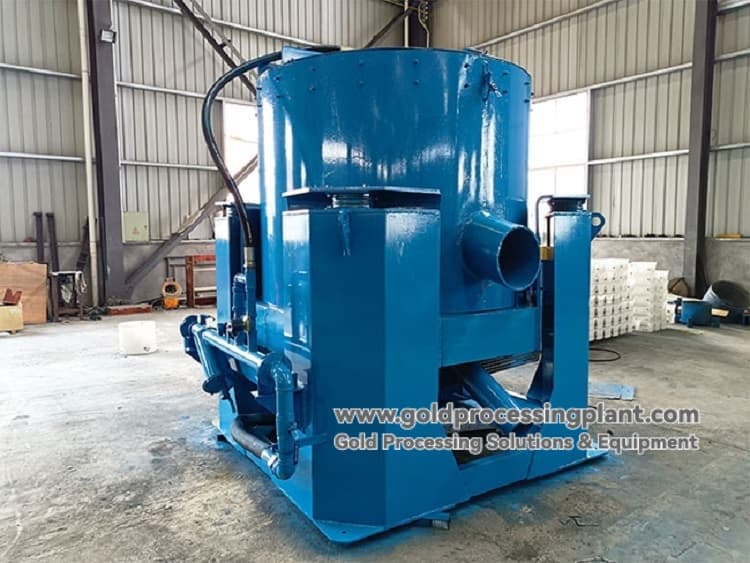
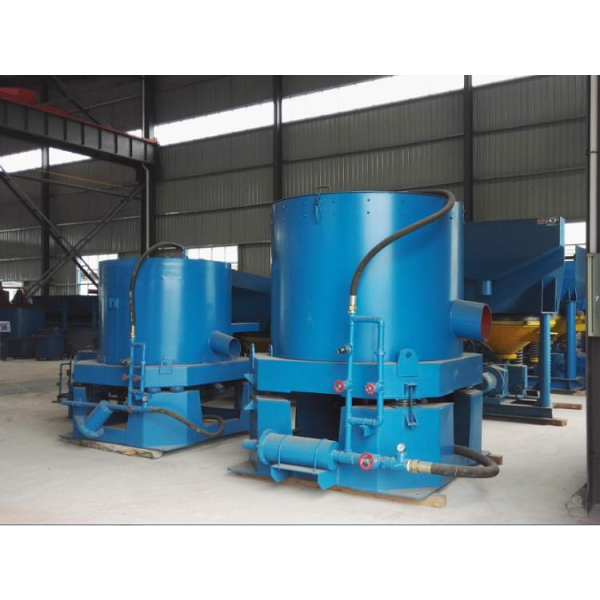
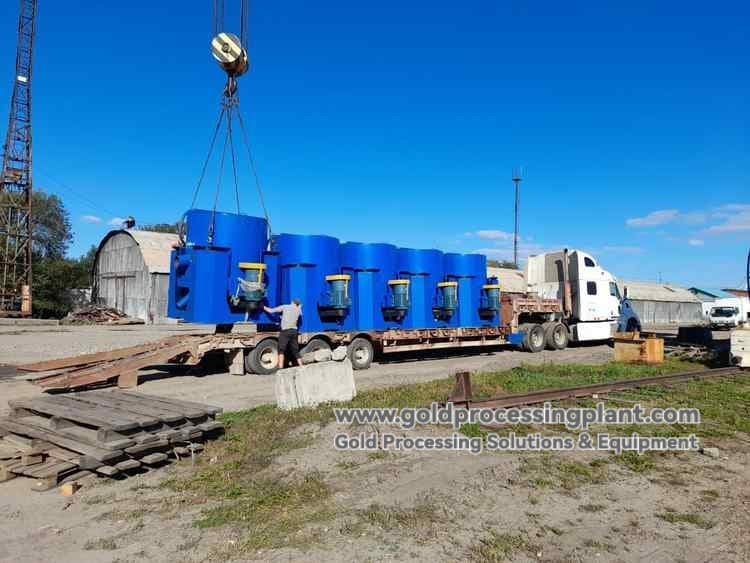
GoldProcessingPlant: actual photo of the fully automatic centrifugal concentrator at a gold processing plant
Centrifugal Concentrator Product Overview
The centrifugal concentrator, also known as a centrifugal separator, is a gravity concentration device that uses centrifugal force to intensify the gravity separation process, representing the most advanced level of gravity concentration technology available. Its core component is a conical concentration cone driven by a motor at high speed and surrounded by pressurized backwash water, with rows of grooves formed by ribbed material distributed along the inner wall. Under centrifugal force, the pulp stratifies by density: heavy minerals such as native gold are thrown into the grooves and enriched into concentrate, while light minerals such as gangue are carried out of the cone by the backwash water and become tailings. GoldProcessingPlant has long specialized in gold mining and processing equipment and beneficiation technology; this centrifugal concentrator incorporates three upgrades to address the three pain points of fine liberated gold in gold ore, namely that it must be captured, retained, and discharged——automatic discharge, shock absorption through flexible connections, and wear-resistant cone liners. It is especially adept at capturing fine liberated gold that is easily lost by chutes and the jig separator, and is widely used in vein gold and alluvial gold processing plants as well as in the re-recovery of auriferous tailings.
Core Working Principle of the Centrifugal Concentrator
-
Pulp feed: the material entering the centrifugal concentrator for separation is generally pulp ground in a ball mill or the overflow pulp from a hydrocyclone. The pulp is fed from the upper part into the bottom of the high-speed rotating concentration cone, providing a steady feed stream for the centrifugal separation of gold-bearing minerals.
-
Centrifugal sedimentation and stratification: the centrifugal force generated by the rotating cone throws mineral particles toward the rows of ribbed grooves on the cone wall. Heavy mineral particles (such as native gold) are subjected to enormous centrifugal force, enabling them to overcome the resistance of the backwash water jets spraying out of the grooves, and they remain retained and enriched in the grooves, forming a layer of gold concentrate.
-
Backwash-water cleaning and tailings discharge: light mineral particles experience much lower centrifugal force and cannot overcome the action of the backwash water; the water flushes them out of the grooves and, driven by the continuous inflow, they overflow from the upper end of the cone and become tailings——achieving efficient separation of gold minerals from gangue.
-
Automatic concentrate discharge: once the preset enrichment cycle is complete, the innovative automatic discharge system flushes and discharges the gold concentrate. The entire process is enclosed and operated with one-button start and stop, eliminating gold-particle loss caused by manual handling of the concentrate and delivering a consistent, qualified gold concentrate to the gold processing plant.
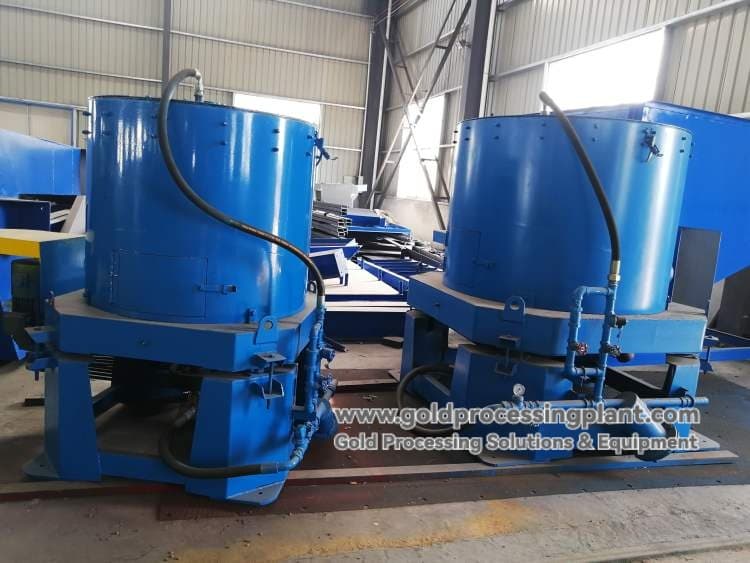
Conical concentration cone and ribbed groove structure of the centrifugal concentrator
Product Advantages and Features of the Centrifugal Concentrator
-
High concentration ratio and high recovery: recovery of fine liberated gold (-0.074mm) is as high as over 98%, alluvial gold recovery is over 99%, and the concentration ratio can reach 1000:1, with separation indices far exceeding those of conventional gravity equipment such as the spiral chute and jigs.
-
Fully automatic concentrate discharge: equipped with an automatic discharge system featuring one-button start and stop; no manual concentrate cleaning is needed when the machine is stopped. The fully enclosed operation prevents gold-particle loss caused by human factors while greatly reducing labor requirements.
-
Stable and reliable processing: the rotation speed of the concentration cone and the backwash-water pressure remain stable and controllable, with minimal fluctuation in gold separation indices, allowing the plant to continuously produce consistent, qualified gold concentrate.
-
Green and environmentally friendly: the separation process adds no chemical reagents whatsoever (no mercury and no cyanide), making it environmentally benign and a clean production alternative to mercury amalgamation.
-
Energy and consumption savings: low water consumption and low power consumption, good wear resistance of wear parts, simple maintenance, and low equipment operating costs.
-
Vibration damping and durability: to counter the strong vibration caused by centrifugal force, the damping section uses flexible connection technology, effectively reducing the negative effects of vibration, improving separation accuracy and extending equipment service life.
-
Compact structure: a small footprint allows easy integration into existing gold processing plant circuits; it can be installed just after the ball mill or at the hydrocyclone overflow without large-scale civil works.
Application Fields and Usage Scenarios
-
Liberated gold recovery from vein gold ore: enrichment and recovery of native gold from auriferous quartz veins, altered-rock-type gold ore, and silicified fracture-zone gold ore, as an alternative to mercury amalgamation.
-
Alluvial gold processing: enrichment of native gold in alluvial gold ore, with recovery above 99%, ideal for alluvial gold washing process plants and mobile gold recovery units.
-
Tailings and residue re-recovery: secondary recovery of gold from old tailings ponds and gravity-separation residues, helping gold mining enterprises revitalize historical stockpiled resources and improve overall gold recovery, while complementing the CIP carbon-in-pulp leaching process.
-
Circuit scavenging to close gaps: installed after the ball mill or at the hydrocyclone overflow, it serves as a high-efficiency scavenging unit specifically capturing the "difficult-to-treat" fine particles in the gold circuit, and can be combined with the gold flotation process.
-
Other heavy minerals: also suitable for the gravity separation and enrichment of other high-density minerals such as tungsten and tin, together with the 6-S shaking table.
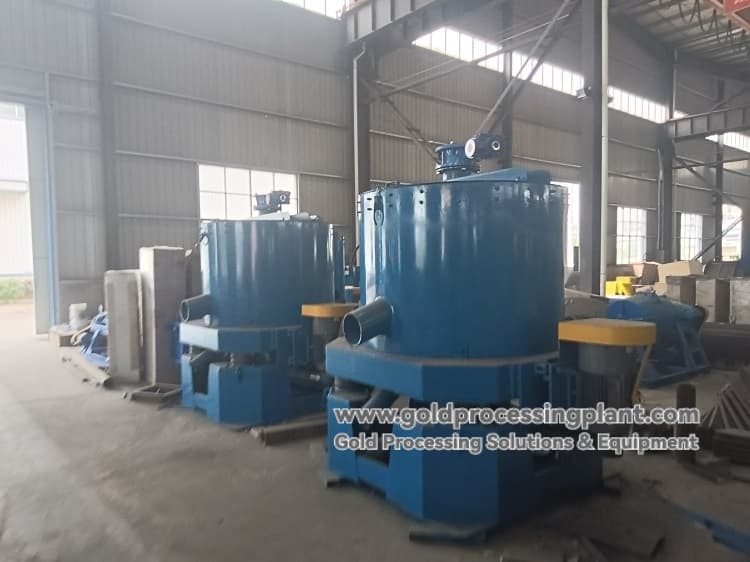
Overall appearance of the fully automatic centrifugal concentrator (with automatic discharge and control system)
Technical Parameters of the Centrifugal Concentrator
| Model and parameters |
STLB20 |
STLB30 |
STLB60 |
STLB80 |
STLB100 |
| Processing capacity (t/h) |
0-0.6 |
2-3 |
8-12 |
40-45 |
60-80 |
| Backwash water consumption (m³/h) |
2-3 |
3-5 |
7-10 |
30-36 |
50-60 |
| Pulp water consumption (m³/h) |
1.5-4 |
5-7 |
8-12 |
40-45 |
60-80 |
| Feed density (%) |
0-50 |
0-50 |
0-50 |
0-50 |
0-50 |
| Feed size (mm) |
0-3 |
0-3 |
0-5 |
0-5 |
0-6 |
| Discharge cycle |
Vein gold 1-3h; alluvial gold 2-6h |
Vein gold 1-3h; alluvial gold 2-6h |
Vein gold 1-3h; alluvial gold 2-6h |
Vein gold 1-3h; alluvial gold 2-6h |
Vein gold 1-3h; alluvial gold 2-6h |
| Discharge per cycle (kg) |
2 |
3-5 |
10-20 |
40-50 |
70-80 |
| Motor power (kW) |
0.75 |
1.5 |
4 |
11 |
18.5 |
| Equipment weight (kg) |
205 |
380 |
1100 |
2300 |
3700 |
| Overall dimensions (mm) |
914×700×900 |
1160×885×1165 |
1820×1450×1700 |
2476×2032×2018 |
2849×2085×2426 |
Model selection recommendations: small-scale gold mine test lines and alluvial gold washing units can choose STLB20 / STLB30; for scavenging in the grinding circuit of a medium-sized vein gold processing plant, STLB60 / STLB80 are recommended; when a large gold processing plant handles ball mill discharge or hydrocyclone overflow, the STLB100 delivers a stable capacity of 60-80t/h. The finer the feed size and the more complete the liberation of gold minerals, the better the centrifugal concentrator supports fine gold recovery; discharge cycles differ between alluvial gold and vein gold, generally 2-6h for alluvial gold and 1-3h for vein gold, and can be set according to gold particle size. GoldProcessingPlant can provide free model selection and circuit layout advice based on capacity and grinding fineness.
Why Choose Our Centrifugal Concentrator?
-
Significant recovery benefits: near-perfect gold recovery directly improves the economics of the processing plant; for high-value gold deposits, the payback period is extremely short.
-
High degree of automation: one-button start and stop with automatic discharge greatly reduces labor costs and operational difficulty while ensuring no loss of gold concentrate.
-
Green and safe: physical separation without mercury or cyanide helps gold enterprises meet environmental production goals and eliminates the health and environmental hazards of mercury amalgamation.
-
Robust and reliable: flexible-connection vibration damping and wear-resistant liner design ensure long-term stable operation of the centrifugal concentrator under harsh mining conditions; full-process support is provided from model selection and the gold mineral processing equipment list to installation guidance and spare-parts supply.
Centrifugal concentrator in operation at a gold processing plant
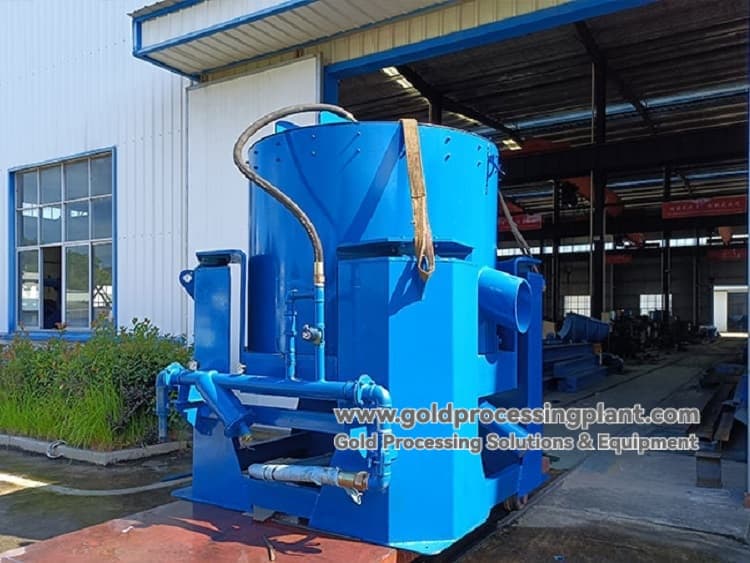
Centrifugal concentrator configuration at a gold processing plant
Frequently Asked Questions about the Centrifugal Concentrator (FAQ)
+What is a fully automatic gold centrifugal concentrator, and how does it differ from a conventional separator?▼
A centrifugal concentrator is a gravity concentration device that uses a motor-driven, high-speed rotating concentration cone to generate a powerful centrifugal force field that intensifies the gravity separation process. Compared with conventional chutes and jigs, it amplifies the separation gravity field by tens to hundreds of times, enabling efficient recovery of fine liberated gold at -0.074mm and even 0.04mm, making it especially suitable for treating fine gold that other gravity equipment tends to lose.
+Which types of gold ore does the centrifugal concentrator mainly recover?▼
It can be used both to enrich native gold in alluvial gold ore and to recover native gold from vein gold ore (auriferous quartz veins, altered-rock-type gold ore, and silicified fracture-zone gold ore), as well as to secondarily recover gold from old tailings ponds and gravity-separation residues. It is a key scavenging unit for gold processing plants seeking higher overall recovery and can be combined with the CIL carbon-in-leach process in downstream tailings treatment.
+What recovery rate can the centrifugal concentrator achieve for fine gold?▼
Plant tests show that alluvial gold recovery exceeds 99% and the concentration ratio can reach 1000 times; when recovering native gold from vein gold ore at a grinding fineness below 0.074mm, liberated gold recovery can exceed 98%, and for the 0.04mm fraction liberated gold recovery remains stable above 97%.
+Can the centrifugal concentrator replace mercury amalgamation for gold extraction?▼
Yes. A gold centrifugal concentrator enriches native gold through purely physical gravity-centrifugal separation, without adding mercury, cyanide, or any other chemical reagent throughout the process. While ensuring high recovery, it completely eliminates the mercury amalgamation method, which is harmful to human health and the environment, making it an ideal alternative for clean gold extraction.
+What improvements does the fully automatic centrifugal concentrator offer over older models?▼
Older-model centrifugal concentrators required manual cleaning of the concentrate when the machine was stopped for discharge, a cumbersome and labor-intensive operation that could easily cause gold-particle loss. The new fully automatic centrifugal concentrator uses automatic discharge; operators only need to monitor the discharge and press the start and stop buttons on the control system to complete all work. The entire process is enclosed, so operators cannot touch the discharged concentrate, avoiding human-caused concentrate loss.
+Does the centrifugal concentrator vibrate heavily during operation, and how is stability ensured?▼
The centrifugal concentrator generates considerable vibration due to centrifugal force. This product uses flexible-connection technology in its damping section, effectively reducing the negative effects of vibration, improving separation accuracy while extending equipment service life, and ensuring a smooth and reliable processing operation.
+Where in the processing circuit should the centrifugal concentrator be installed?▼
It is usually installed after the ball mill or at the hydrocyclone overflow, serving as a high-efficiency scavenging unit specifically capturing the "difficult-to-treat" fine gold after grinding and classification. Its compact structure and small footprint make it easy to integrate into the circuit of an existing gold processing plant, within a complete gold plant solution, without the need for major modifications.
+What are the feed density and feed size requirements for the centrifugal concentrator?▼
The feed density range is wide, allowing stable operation between 0-50% with strong tolerance to fluctuations; feed size varies by model from 0-3mm to 0-6mm. Classification before feeding is recommended to ensure complete liberation of gold minerals and improve the enrichment performance of the centrifugal concentrator.
+Does the centrifugal concentrator require reagents, and are operating costs high?▼
No chemical reagents are needed; it is purely physical gravity separation. The equipment has low water and power consumption, good wear resistance of wear parts, and simple maintenance, resulting in low operating costs; automatic discharge further reduces labor during shutdowns, so the overall operating cost is significantly lower than that of conventional gravity equipment.
+What information is required to obtain a quotation for a centrifugal concentrator?▼
Please provide the gold ore type (alluvial / vein / tailings), hourly capacity (t/h), grinding fineness, feed density, and site layout conditions. We can then match you with the appropriate model from STLB20 to STLB100 and provide a centrifugal concentrator configuration scheme, circuit layout recommendations, and a quotation.
Get a Fully Automatic Gold Centrifugal Concentrator Selection Plan and Quotation
All models STLB20 / STLB30 / STLB60 / STLB80 / STLB100 are available, with supply of single units and scavenging-unit packages for grinding circuits. They suit new vein gold and alluvial gold processing plants, efficiency upgrades of existing plants, and tailings re-recovery, as well as gravity separation of other heavy minerals such as tungsten and tin.
Tell us your gold ore type, capacity, and grinding fineness, and GoldProcessingPlant's mineral processing engineers will match the centrifugal concentrator model and installation position for you, providing a configuration scheme, estimated quotation, and wear-parts list to help you recover fine liberated gold at lower cost and improve overall gold recovery.
Visit our contact page to submit your processing requirements and request centrifugal concentrator selection and quotation